PRINCE WILLIAM QUIETLY WALKED INTO A SMALL RESCUE SHELTER ON THE BRINK OF CLOSING WITH JUST 48 HOU& LEFT BEFORE WERY CAT INSIDE WOULD BE EUTHANIZED
In a world saturated with headlines, press conferences, and carefully managed public images, the most powerful stories are often the ones that unfold in silence.
The story of Prince William quietly walking into a struggling animal rescue shelter—just 48 hours before it was set to close and euthanize every cat inside—is one such moment.
Not because of spectacle, but because of sincerity. Not because of dub, but because of choice.

The shelter was at the end of its road. Bills were overdue, funding had vanished, and options had run out.
Thirty-nine cat healthy, gentle, and undeserving of their fat were scheduled to be euthanized for one reason only: there was nowhere left for them to go.
For the staff and volunteers, the countdown felt unbearable. Years of care, love, and effort were about to end in heartbreak.
Then, without warning and without witnesses, Prince William walked through the door.
There were no cameras. No aides announcing his arrival. No press releases.

He did not come as a royal figure expecting recognition, but as a human being responding to quiet suffering.
Dressed simply and speaking softly, he declined any special treatment and moved instinctively toward the back of the shelter—where the oldest and weakest animals waited, often unseen and overlooked.
It was there that he met Buddy.
Buddy was an J1-year-old tabby mix, curled into the corner of a worn blanket.
He was too tired to lift his head, too old to be considered “adoptable,” and too close to the end of a life that had offered him very little kindness.
For most visitors, Buddy would have blended into the background. For Prince William, he became Me center of the moment.
William knelt beside him, gently placing a hand on his head. He didn I rush. He didn t speak immediately.
He allowed the silence to exist, as if recognizing that presence alone can be a form of comfort.
Only after a pause did he ask the shelter caretaker a simple question: “How many cats are here?”
“Thirty-nine,” she replied, her voice breaking.
William nodded. There was no hesitation, no visible calculation. He didn’t consult advisors or make calls.
He simply said, with calm certainty, “All 39 deserve a tomorrow.” Those words changed everything.
By the next morning, delivery vehicles arrived at the shelter gates. New bedding was installed. Floors were replaced.
High-quali food and medical supplies were delivered.
Scratching posts, grooming tools, and upgraded 1!v1ng spaces transformed the once-fading shelter into a place of warmth and d!gniy.
Outstanding debts were paid in full. Veterinarians were brought in to examine every animal.
Above each enclosure, a small wooden sign appeared, simple and unadorned: “Forever home — with care from \/Villiam.”
Yet the most emotional moment came quietly, away from any announcement.
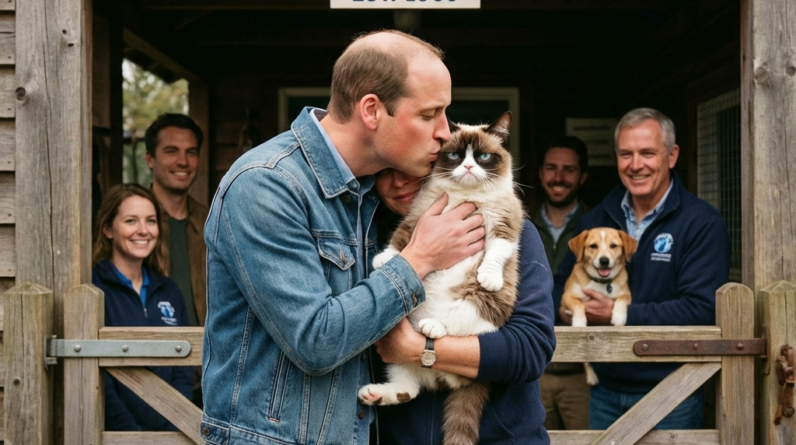
As Buddy was gently lifted for a medical check, Prince William stepped forward and said, “I’ll take him.”
The room fell silent.
Buddy—the cat who had spent more than a decade being passed over—finally had a home. Not as a symbol.
Not as a gesture. But as a living being chosen simply because he mattered. “He’s waited long enough,” William said later. ‘ I think it’s time he went home.” That single decision spoke volumes.
It revealed a truth often lost in discussions of leadership and responsibility: compassion is not abstract. It is personal.
It shows itself in who we notice, who we choose, and who we refuse to leave behind.
Prince William did not share this story online. He did not attach it to a campaign or a message.
He did not notify the press.
The world only learned about it days later, when a volunteer—overwhelmed by what had happened—felt that such quiet goodness deserved to be known.
In an age where public figures are often judged by statements rather than actions, this moment resonated deeply.
It reminded people that responsibility does not always announce itself loudly. Sometimes it arrives softly, kneels down, and listens.
The story also challenges how we think about power. True influence is not always exercised from podiums or palaces.
Sometimes it appears in places the world rarely looks—small shelters, forgotten corners, and lives deemed expendable by circumstance.
By choosing to act there, Prince William demonstrated that leadership is not about visibiliy, but about willingness.
This act did not solve the global crisis of animal homelessness. It did not pretend to.
What it did was simpler and more honest: it helped where help was needed, fully and without condition.
It offered safety, dignity, and time—things that every life deserves, regardless of size or status.
Perhaps that is why the story has moved so many people. It is not about royalty. It is about recognition.
Recognition that compass